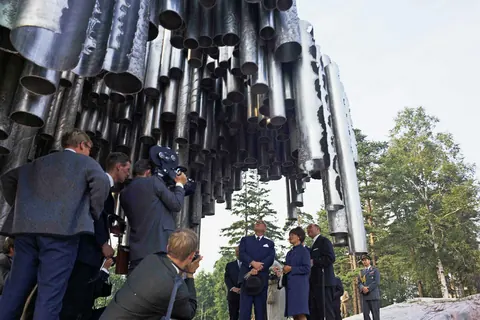
The Sibelius Monument is a public art memorial to the Finnish composer Jean Sibelius, who died in 1957. Situated in Sibelius Park within the Töölö district of Helsinki, the monument is by the Finnish sculptor Eila Hiltunen, whose design, Passio Musicae, won a contentious, and therefore protracted, competition that the Sibelius Society of Finland held from 1961 to 1962. After five additional years of work by Hiltunen and her assistants, the completed monument received its unveiling at a ceremony on 7 September 1967, when the Sibelius Society donated it to the City of Helsinki. As with other items in the city’s art collection, it is managed and curated by the Helsinki Art Museum.
The monument comprises two distinct elements, each installed on granite natural to the terrain. The first, original to Hiltunen’s proposal, is an abstract cluster of 569 acid-resistant stainless steel pipes, decoratively textured and welded together in an undulating pattern; visitors can stand within the resulting cavity. Hiltunen intended the cluster, which measures 8.5 by 10.5 by 6.5 metres and weighs 24 tonnes, to symbolically evoke Sibelius’s music. Nevertheless, observers have tended to find it representational of an organ or of the Finnish landscape, such as its birch woodlands and shore reeds. Although Hiltunen did not design Passio Musicae to be a sound sculpture, the pipe cluster can generate sounds due to wind, rain, and echoing voices and birdsong. The monument’s second element, which the society required Hiltunen to add as a figurative concession to critics of her abstract approach, is a high-relief portrait of Sibelius in his mid-forties, cast of acid-resistant stainless steel and framed by three free-form shards. Because the two elements were pickled and passivated, the monument has neither patinated nor corroded over time.
Despite the polarized figurative–abstract discourse that accompanied Passio Musicae’s commissioning, the Sibelius Monument has become one of the most recognized sights of the Helsinki cityscape and ranks among Finland’s most visited tourist attractions. It is Hiltunen’s most famous work and is credited with helping to modernize Finland’s then-conservative, male-dominated art scene. In addition, the Finnish state has utilized the Sibelius Monument as a tool of cultural diplomacy, for example by donating Hiltunen’s studies to UNESCO in 1967 and the United Nations Headquarters in 1983.
Sources
Text: introduction of the Wikipedia article Sibelius Monument, under the CC BY-SA 4.0 licence (authors: article history). Facts: Wikidata (CC0). Coordinates: Wikidata, map background © OpenStreetMap contributors.