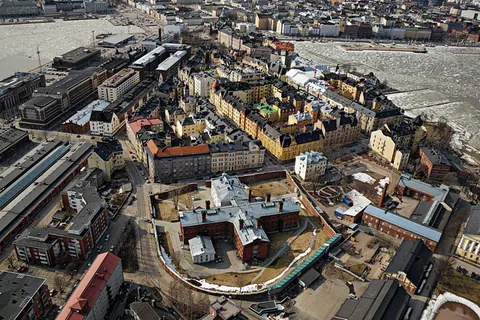
Katajanokka is a neighbourhood of Helsinki, Finland, with around 5,000 inhabitants in 2023. The district is located adjacent to the immediate downtown area, though in the first major town plan for Helsinki from the mid-18th century, the area fell outside the fortifications planned to encircle the city.
Originally, Katajanokka was a headland of the Helsinki peninsula but is now technically an island, as a small canal was dug across the base of the headland in the 19th century. There are four bridges across the canal connecting Katajanokka with the Helsinki Market Square and Aleksanterinkatu area in mainland Helsinki.
Buildings in Katajanokka include the former Katajanokka prison, the Uspenski Cathedral, the Katajanokka Casino, Wanha Satama, the Stora Enso head office designed by Alvar Aalto, the building of the Ministry for Foreign Affairs and the Katajanokka Terminal used by Viking Line. Katajanokka forms a central part of the South Harbour. In the 19th and 20th centuries Katajanokka was known as an important hub for goods transport and even became the largest import harbour in Finland, but since then its role as a residential area has increased. Katajanokka is served by the Helsinki tram lines 4 and 5.
Katajanokka is one of the most distinguished neighbourhoods in Helsinki. Katajanokka’s residents have included former Finnish President Mauno Koivisto, composer Einojuhani Rautavaara and author-artist Tove Jansson.
Places in the district
- Uspenski Cathedral490 m
- Market Square740 m
- Old Market Hall870 m
- Senate Square920 m
- Helsinki Cathedral970 m
Sources
Text: introduction of the Wikipedia article Katajanokka, under the CC BY-SA 4.0 licence (authors: article history). Facts: Wikidata (CC0). Coordinates: Wikidata, map background © OpenStreetMap contributors.